
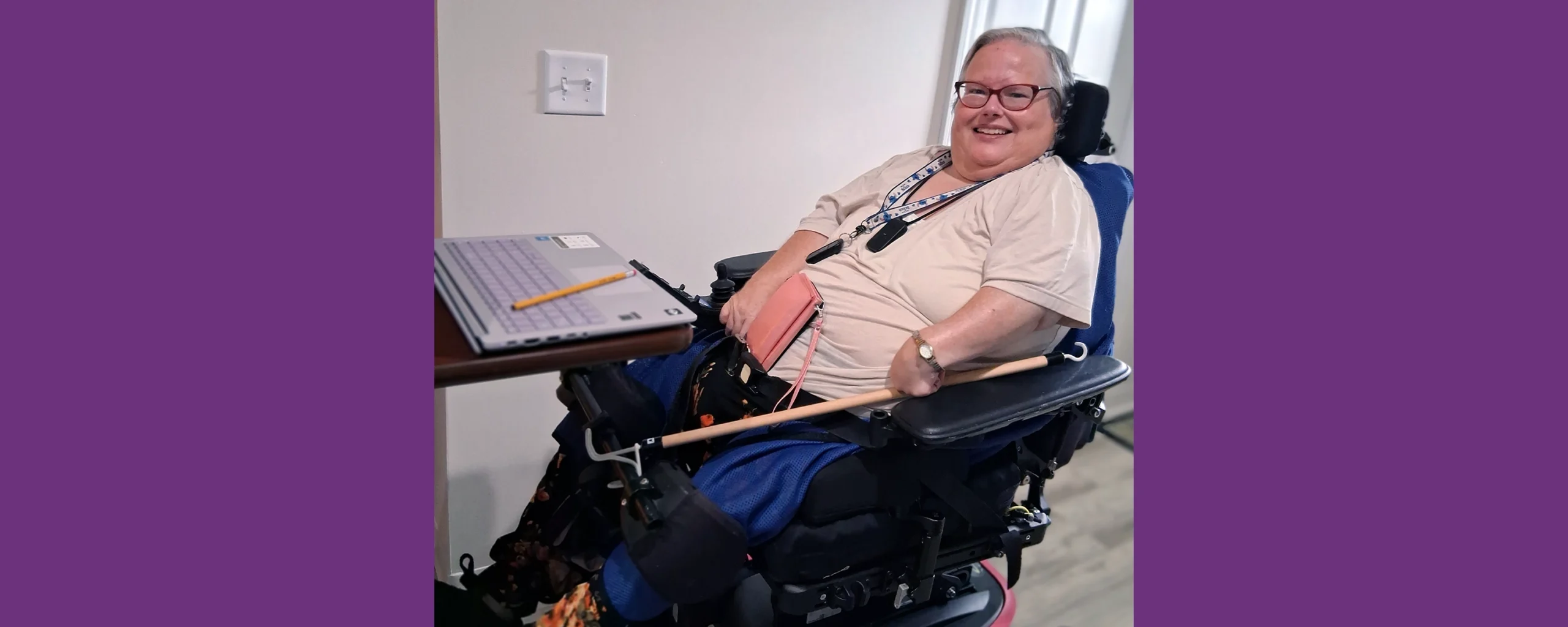
Sandy’s Story
By Christine Bailey
Sandy has been living with a disability, arthrogryposis multiplex congenita (AMC), her entire life. Raised by parents who wanted her to be as independent as possible, she learned from an early age to speak up for what she needed. Her mind is sharp and her voice strong even if her body has many limitations. Sandy earned her advanced degree in social work to help others with disabilities. She is passionate about disability rights, worked for years in education, advocacy, and counseling and continues to advocate for state programs like Money Follows the Person (MFP) and Community First Choice (CFC).
Already familiar with MFP in her social work role, she knew she’d need to apply for this program when rehabilitation after a knee replacement in 2016 was compounded with managing her other health conditions. Sandy had to accept the new reality that she’d now need to use a wheelchair rather than just a walker. Independence would look different. Sandy worked with the Center for Disability Rights through MFP to receive a customized motorized wheelchair, and other adaptive equipment like a Hoyer lift and shower chair with wheels, apply for social security disability, and even return to work part time. Using a pencil, she can navigate the keyboard on her laptop despite limited use of her hands. She has been very fortunate to have had consistent personal care assistance (PCA) for the last 20 years. Sandy was also lucky to have housing that she could return to when she transitioned through MFP onto the PCA waiver program. However, since she needed two PCAs to overlap shifts and provide maximum assistance with her daily needs, she paid out of pocket for additional PCA time beyond the PCA waiver program’s allowable number of hours. Although still able to work from home, her family had to help financially with the added expenses.
When a bone compressed her spinal cord, she was hospitalized. Due to a high A1C level, she could not have surgery and needed to be on injectable insulin to control her diabetes. She learned of an opening at a nursing home where she had been on a waitlist. Back in the nursing home for rehabilitation, she reapplied to MFP in 2025. She expected to be in the facility for only a few months, but it took more than a year to return to living in the community. She could not return to her former apartment, but she learned of new accessible apartments under construction and applied. There were many setbacks along the way: paperwork and credit requirements; delays getting needed home modifications due to the contractor bidding process; and MFP staff changes. Recently, she moved into her new apartment which includes features like an automatic door opener operated with a button on a pendant she wears, a hospital bed, a portable ceiling lift, and bathroom adaptations enabling her to regain her independence. Another barrier involved management of her injectable insulin. Since Sandy could not self-administer due to her hand contractures, a long-time PCA was willing to learn to give Sandy her insulin at night with an injectable pen.
Sandy does not let obstacles stand in her way. She demonstrated patience, faith, and advocacy to create a new home for herself and also in working for others using Medicaid programs that could be threatened by federal or state funding cuts. While still in the nursing home earlier this year, she rallied with others at the Connecticut State Capitol regarding some proposed changes that would have negatively impacted new CFC applicants.
Despite dealing with many challenges, Sandy hopes to return to work. She is exploring an opportunity to supervise social work students and inspire them in the field of disability rights.
Read the CT Money Follows the Person Quarterly Report
MFP Demonstration Background The Money Follows the Person Rebalancing Demonstration, created by Section 6071 of the Deficit Reduction Act of 2005, supports States’ efforts to “rebalance” their long-term support systems, so that individuals can choose where to live and receive services. One of the major objectives of Money Follows the Person (MFP) is “to increase the use of home and community based, rather than institutional, long-term care services.” MFP supports this by offering grantee States an enhanced Federal Medical Assistance Percentage on qualified services. MFP also offers states the flexibility to provide supplemental services, such as assistive technology and enhanced transition services, to assist in successful transitions. States are then expected to reinvest the savings over the cost of institutional services to rebalance their long-term services and supports for older adults and people with disabilities to a community based orientation.