
Sally’s Story
By Aaron Tiscione and Amy Zazon
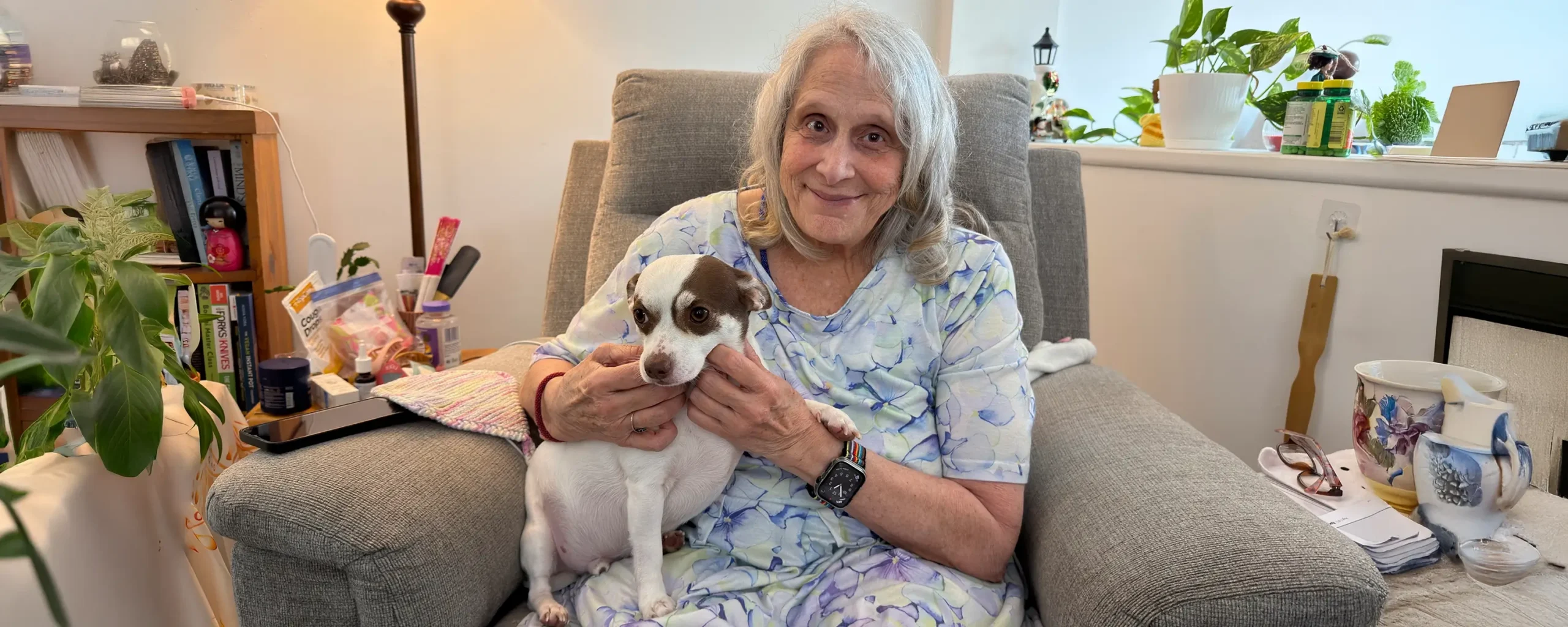
Sally has always been someone who takes care of others. Whether it was for her dogs, her home, or those around her, she found purpose in nurturing. That sense of independence was disrupted after Sally lost her home due to a motor vehicle crash and moved in with her daughter. While trying to adjust to this new normal, Sally experienced a serious fall caused by a broken walker wheel which led to a fractured hip, emergency surgery, and a pulmonary embolism. “The ICU saved my life,” she recalls. What followed was an extended stay in a nursing home — away from her dogs, her kitchen, and her independence.
Although the facility kept her safe, it didn’t feel like home to Sally. “Not having my dogs anymore hurt the most,” she reflects. Sally knew she wanted to return to the community but didn’t know how to make that possible. That changed when she discovered the Money Follows the Person (MFP) program through a social worker at the facility, who explained that MFP would help her find a place to live and the support she needed to live independently.
Sally’s MFP team brought her to four different apartments before they found the right one. She toured it with a physical therapist and an aide, who evaluated the space to ensure it would be a safe new home for Sally, but she still worried it wouldn’t feel like home. MFP helped with that, furnishing her apartment with a wardrobe and a bookcase. Her PCA also played an important role in her transition back into the community. She helped support Sally when she needed it, but more than that, she had become a dear friend and companion.
As Sally settled into her new home, she began rebuilding the parts of life that mattered most to her. With the help of her PCA, she welcomed a new four-legged friend named Timmy into her home. Timmy is a critical part of Sally’s life. He encourages her to walk more and helps with her recovery. He rides along to her doctor’s appointments, settling her anxiety. “He’s my emotional support dog,” she says. “He calms me down. He’s always there. I can’t imagine my life without him.” Sally glows as she talks about him, petting his head as he sits protectively on her lap.
Sally also began decorating her apartment with plants, a large plant stand anchoring the room, pots along the windowsill, all of them beautifully presented and soaking up the light. She propagates cuttings
and shares them with those who visit, some of them gifted to her by her PCA. “I just love my plants,” she says. “They’re great for the air. . . they’re good therapy.”
With Timmy nearby and her plants filling every corner, Sally reflects on what coming home through MFP has meant to her. “It gives you something to do,” she says.. “It answers the question ‘what am I doing here?’” Surrounded by light, life, and all the things she cares about, she’s found a new sense of purpose. “It’s so important to have a place that makes you smile, a place of your own. I wake up every morning, and I can’t believe I’m here.”
Read the CT Money Follows the Person Quarterly Report
MFP Demonstration Background
The Money Follows the Person Rebalancing Demonstration, created by Section 6071 of the Deficit Reduction Act of 2005, supports States’ efforts to “rebalance” their long-term support systems, so that individuals can choose where to live and receive services. One of the major objectives of Money Follows the Person (MFP) is “to increase the use of home and community based, rather than institutional, long-term care services.” MFP supports this by offering grantee States an enhanced Federal Medical Assistance Percentage on qualified services. MFP also offers states the flexibility to provide supplemental services, such as assistive technology and enhanced transition services, to assist in successful transitions. States are then expected to reinvest the savings over the cost of institutional services to rebalance their long-term services and supports for older adults and people with disabilities to a community based orientation.